 Previous: Vayera

Daily Zohar # 5290 – Vayera – The end of all flesh has come before Me
Daily Zohar 5290
Hebrew translation:
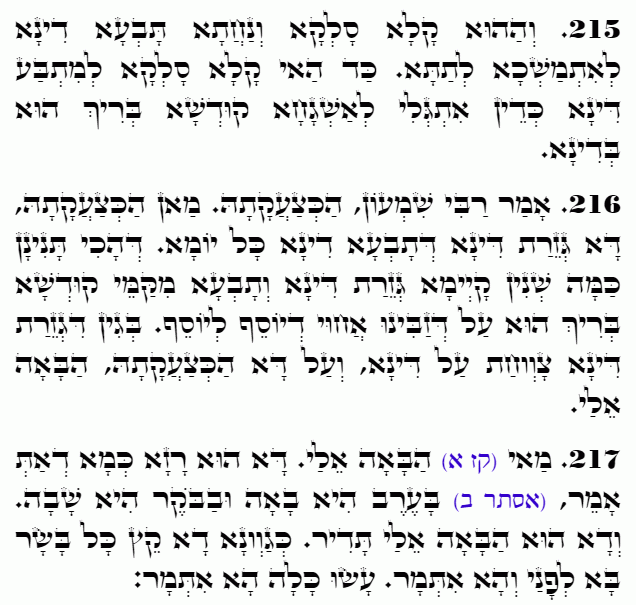
216. אָמַר רַבִּי שִׁמְעוֹן, הַכְּצַעֲקָתָהּ, מִי הַכְּצַעֲקָתָהּ? זוֹ גְזֵרַת הַדִּין שֶׁתּוֹבַעַת דִּין כָּל יוֹם. שֶׁכָּךְ שָׁנִינוּ, כַּמָּה שָׁנִים עוֹמֶדֶת גְּזֵרַת דִּין וְתוֹבַעַת מִלִּפְנֵי הַקָּדוֹשׁ בָּרוּךְ הוּא עַל שֶׁאֲחֵי יוֹסֵף מָכְרוּ אֶת יוֹסֵף, מִשּׁוּם שֶׁגְּזֵרַת הַדִּין צוֹוַחַת עַל הַדִּין, וְעַל זֶה הַכְּצַעֲקָתָהּ הַבָּאָה אֵלַי.
217. מַה זֶּה הַבָּאָה אֵלַי? זֶהוּ סוֹד כְּמוֹ שֶׁנֶּאֱמַר (אסתר ב) בָּעֶרֶב הִיא בָאָה וּבַבֹּקֶר הִיא שָׁבָה. וְזֶהוּ הַבָּאָה אֵלַי, תָּמִיד. כְּמוֹ זֶה קֵץ כָּל בָּשָׂר בָּא לְפָנַי, וַהֲרֵי נִתְבָּאֵר. עָשׂוּ כָּלָה, הֲרֵי נִתְבָּאֵר.
.
Zohar Vayera
Continued from previous DZ
#215
And that voice ascends and descends and demands judgment to be drawn below. When this voice ascends to demand judgment, then the Holy One, blessed be He, is revealed to watch over the judgment.
The meaning: the judgments that are in the world are divided into two aspects. One comes from Malchut herself, and the voice that ascends from these judgments is called the voice from below, that is, of Malchut. Two, from the aspect of Malchut that is sweetened in Binah, and the voice that ascends from these judgments is called the voice from above, that is of Binah. And likewise it is called the voice of the hail, and it hints at the verse “קולות וברד” “voices and hail” (Exodus 9:23) that is said of the plagues of Egypt. The matter of these two voices is explained above. “קוטרי” (Kotrei) means thickets; a matter that is tangled, hard to loosen and open, is called kotrei, as it is written, “קטיר קא חזינא הכא” “a knot I see here” (Yevamot 61a). And likewise “תרי קוטרי עבדי ביה” “two knots he made in it” (Yevamot 107b). Shoulder means Mochin of the back of the body, for the shoulder is behind the face. One drop means a drop of the point of the shuruk. For the three points cholam, shuruk, chirik, from which all the Mochin are drawn, are called three drops. The great deep means the powers of judgment that are drawn from Binah.
Notes:
The voice that ascends and descends demands judgment, and then the Holy One, blessed be He, is revealed to watch over it. Judgments come either from Malchut herself, the lower voice, or from Malchut sweetened in Binah, the upper voice, also called the voice of the hail. The thickets gather into the drop of the shuruk, from which the Mochin come.
#216
Rabbi Shimon said, “It is written, ‘הַכְּצַעֲקָתָהּ”whether according to its cry'” (Genesis 18:21). From whom is this “whether according to its cry”? And he answers: This is the decree of judgment that demands judgment every day. The verse says, “whether according to its cry.” For thus we have learned: for many years the decree of judgment stood and demanded of the Holy One, blessed be He, what the brothers of Joseph sold him to Egypt, for the decree of judgment cries out that the judgment should be revealed. Therefore the verse says, “whether according to its cry that has come to Me,” that is, the cry of the decree of judgment.
The meaning: the decree of judgment is the secret of the shining of the point of the shuruk that is in the Nukva, before her inclusion in the Chassadim, which is not revealed except with the revelation of judgments, as above. And the secret of Joseph is the secret of the shining of the three upper ones. And when Joseph’s brothers sold him to Egypt, the three upper ones departed from them. And this is what Rabbi Shimon hints at: that she demanded concerning the nullification of her shining because of the sale of Joseph, for she wanted to cry out and reveal the judgment, that is she wanted to return the three upper ones(ג” ר) that are nullified by the sale of Joseph. Since her shining is only with the revelation of judgment, as above, her shining is hinted at in the secret of crying out over judgment. And of this, “whether according to its cry that has come to Me,” that is the revelation of the Chochmah by means of the cry of the decree of judgment.
Notes:
“Whether according to its cry” הַכְּצַעֲקָתָהּ is the decree of judgment that demands every day. It stood for many years, demanding judgment over the sale of Joseph; the shining of the shuruk in the Nukva is revealed only with judgments, and the sale of Joseph removed the three upper ones.
#217
And he asks: What does the verse teach us in the words “that has come to Me”? And he says: This is a secret, as you say, “בָּעֶרֶב הִיא בָאָה וּבַבֹּקֶר הִיא שָׁבָה” “In the evening she comes, and in the morning she returns” (Esther 2:14). That is, after he explained the word “whether according to its cry,” which is the secret of the revelation of the shining of the Chochmah by means of the cry of the decree of judgment, as in the adjacent teaching, he explains the words “that has come to Me,” which is in the present tense, that its meaning is that she comes at the time of the union. As it is written, “in the evening she comes,” which hints at the time of that union that receives from the shining of the shuruk, which is called evening, for it is under the rule of the judgments of the shuruk, which is the secret of “וַתָּקָם בְּעוֹד לַיְלָה” “And she rises while it is yet night” (Proverbs 31:15). And this is “that has come to Me” continually. Therefore it is written “that has come to Me” (הבאה אלי) in the present tense, because it is practiced continually. At the beginning of every union, the rule of the shuruk is practiced in the secret of the shining of the left line. In the same manner, “קֵץ כָּל בָּשָׂר בָּא לְפָנַי” (“The end of all flesh has come before Me,” Genesis 6:13) has been said. In this manner, the verse says, “the end of all flesh has come before Me,” and it also says in the present tense, “has come before Me.”
Notes:
“That has come to Me” is in the present tense, for she comes at the time of the union, under the rule of the shuruk, called evening. This is practiced continually at the beginning of every union, like the verse “the end of all flesh has come before Me.”
Friday would be a good day to make a ** Donation, especially if you didn’t donate in the past week. Giving on Friday, an aspect of Yessod, expands the vessel for the Light and honors Shabbat.
** Your donation doesn’t have to be given to the same place every week. You can alternate or split your donation among those who benefit you spiritually.
Support – Ohr HaCarmel Yeshiva
Tap here: Ohr HaCarmel Donation Page to contribute and connect spiritually with Israel.
Yeshiva Ohr HaCarmel (which means the Light of the Carmel) sits atop Mount Carmel, where the prophet Elijah’s prayers were answered.

 Join Zohar Sparks - Telegram (Not a chat group)
 Join on WhatsApp (Not a chat group)
 Join on Signal (Chat is available only in this group)